Parashqevi Qiriazi: the only woman at the Congress of Manastir
Teacher, founder of the “Morning Star” society, representative in Paris in 1919 and a life that ended under persecution
Translated from the Albanian original by the editors. Shqip

Settings
Line spacing
Typeface
Appearance
Parashqevi Qiriazi was born on 27 May 1886 in Manastir, into the Qiriazi family, one of the most important families in Albanian education. She was the youngest sister of Gjerasim, Gjergj and Sevasti. As a girl of about 11 she helped her brother and sister teach written Albanian to the girls at the Korçë school, opened in 1891.
Education and teaching
In 1904 she graduated from the American College for Girls in Istanbul. After graduating she went to Korçë to take over from her sister Sevasti as head of the girls' school. So the school that had taught her her first letters was now led by her.
The Congress of Manastir
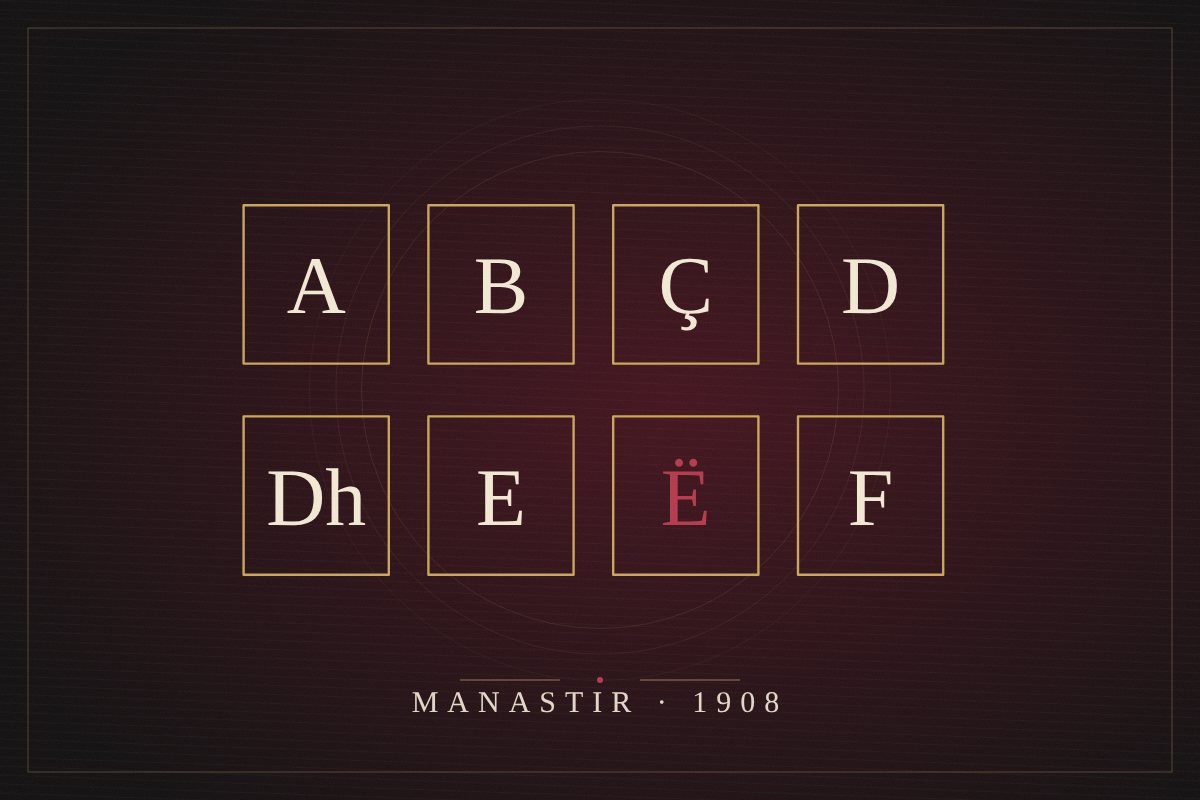
In November 1908 Parashqevi took part in the Congress of Manastir, which decided on the Albanian alphabet. She was the only woman among the delegates. Her presence was not symbolic: she represented the Korçë girls' school and a whole tradition of Albanian education that her family had built over the years.
In the hall where the alphabet was chosen there was only one woman. But she was not there to watch. She was there because she had taught hundreds of girls to write.
"The Morning Star"
In 1909 she helped found the society Ylli i Mëngjesit ("The Morning Star"), which worked for the education and emancipation of women. After emigrating to the United States, from 1917 to 1920 she published, with her sister, the magazine of the same name. In 1919 she was one of the few women sent to the Paris Peace Conference to represent Albanian interests, on behalf of the Albanian-American community.
In Albania
In 1921 she returned to Albania and helped found the Qiriazi family's institute for girls in Tirana and Kamëz. In 1928 she took a leading role in the organisation Gruaja Shqiptare ("The Albanian Woman"). During the Second World War she was an outspoken anti-fascist, and in 1943 she and her sister were interned in the Banjica camp near Belgrade.
The college in Istanbul
The American College for Girls in Istanbul, where both Qiriazi sisters studied, had been founded by American missionaries in the nineteenth century and was among the few institutions in the Ottoman Empire where girls could receive higher education. Armenian, Bulgarian, Greek, Turkish and Albanian girls studied there, and teaching was mainly in English. For Parashqevi this college was not only a place of study, but also an example of how a school could prepare girls to become teachers and leaders in their communities. She brought this model to Korça.
Paris, 1919
Her participation in the Paris Peace Conference came at a very dangerous moment for Albania. After the First World War, Italy, Greece and Yugoslavia had claims on Albanian territory, and in 1919 an agreement between Italian and Greek diplomats on the partition of Albania became known. The Albanian delegates, among them representatives of the American diaspora, tried to convince the Great Powers that Albania should remain independent. The American president Woodrow Wilson opposed the partition, and in 1920 Albania was admitted to the League of Nations.
Albanian women in the 1930s
In the 1920s and 1930s the organisation Gruaja Shqiptare ("The Albanian Woman"), in which Parashqevi held a leading role, worked for girls’ education, hygiene and women’s participation in public life. In this period the Albanian state undertook some important reforms for women, such as the ban on face-veiling in 1937. These reforms were imposed from above and often met resistance, but they created space for educated women who, like Parashqevi, had worked for decades to bring girls out of illiteracy.
The end of private schools
In 1933 King Zog’s government amended the constitution and decided that education should be exclusively state-run. Private and foreign schools were closed or nationalised, including the Qiriazi family’s girls’ institute in Kamëz. The stated aim was to strengthen the national school and limit foreign influence. For the Qiriazi sisters this was a heavy blow: the work of their whole lives was interrupted not by the enemies of Albanian education, but by the Albanian state itself.
Persecution
After the war the Qiriazi family was persecuted by the communist regime and, according to the sources, forced to leave Tirana. The efforts of Skënder Luarasi and Vito Kapo later led to a partial rehabilitation. Parashqevi Qiriazi died in Tirana on 17 December 1970.
A name that came back
For decades, under the communist regime, the names of the Qiriazi sisters were rarely mentioned, because the family was linked to Protestantism and to America. After 1990 their work was rediscovered by scholars and teachers. Today schools and institutions in Albania, Kosovo and North Macedonia bear their names, and 7 March, Teachers’ Day, commemorates the opening of the Korça Mësonjëtore in 1887, a tradition the Qiriazi sisters continued for girls. In this way their story returned to where it had begun: the classroom, among the pupils for whom they had worked all their lives.
Why it matters today
The history of the National Awakening is often told as a history of men: poets, diplomats, fighters. Parashqevi Qiriazi reminds us that without the women teachers who opened schools for girls, and without the women who demanded the right to education, the Manastir alphabet would have been left without readers.
Sources and further reading
- Parashqevi Qiriazi. Wikipedia
- Qiriazi family. Wikipedia
- Congress of Manastir. Wikipedia
- Albanian Institute for Protestant Studies. Who was Paraskevi Kyrias? instituti.org
- Fischer, B. J. (1984). King Zog and the Struggle for Stability in Albania. Boulder: East European Monographs. WorldCat
- Vickers, M. (1999). The Albanians: A Modern History. London: I.B. Tauris. WorldCat